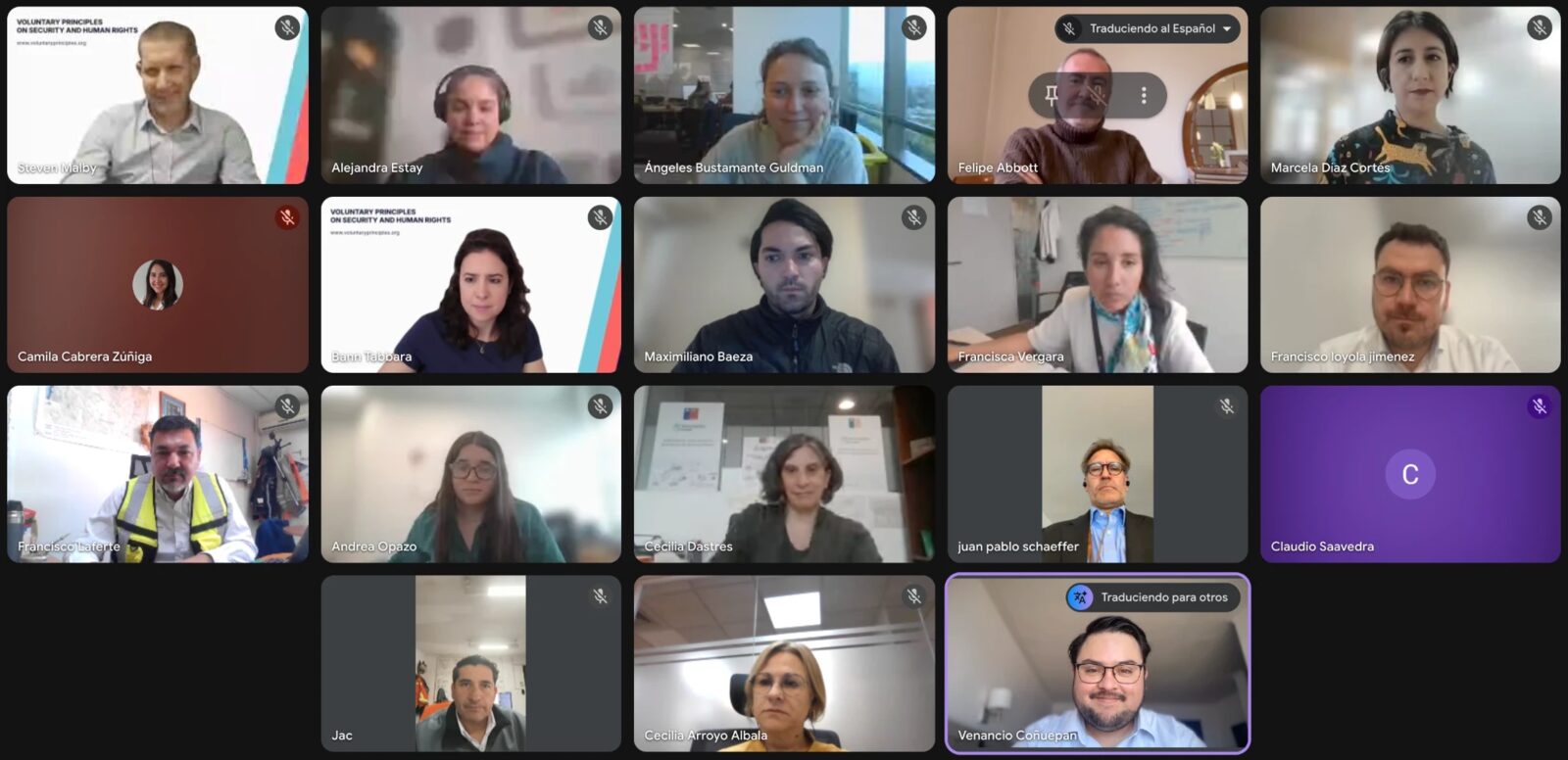
On 29 October 2026, the Chile Working Group held an online introductory meeting with the office of the Executive Director of the Voluntary Principles Initiative (VPI), led by Dr. Steven Malby. The Group shared a review of its first year of work, and Malby presented the Initiative's proposed strategy for 2027-2030.
The meeting opened with a round of introductions by the members of the Group. Representatives of its three pillars —Government; Business; Civil Society, Academia and Indigenous Peoples— attended, as did representatives of two ministries invited to the meeting.
The Group's first year
The Group's Executive Secretariat reviewed the ground the Group has covered since its inauguration on 5 September 2024. Between July 2025 and May 2026 the Group held four ordinary sessions, followed by an extraordinary session in June 2026. During that period it carried out a field visit and adopted the Chatham House rules for its internal work and a protocol for incorporating new members. Between July and October 2026 it worked on draft internal regulations.
The presentation included the diagnostic survey the Group conducted between October 2025 and February 2026, with 13 responses to 15 invitations. It identified five gaps: uneven knowledge of the Principles, few practical tools for Chile, limited Indigenous participation, weak coordination with the State, and a lack of support for the implementation of Law No. 21,659 on private security. The opportunities identified by the survey also gave rise to six proposed work lines, subject to validation by the Group's plenary.
For the second year, the proposal is to move from diagnosis to implementation on four fronts:
- Leveling and outreach: workshops on the Principles, one per pillar, and a talk on the Private Security Law and human rights, among other actions.
- Implementing the Principles: a guide to contracting and monitoring private security and a protocol for engaging with Indigenous peoples, among other tools.
- Coordination with the State: meetings with the new sectoral authorities, among other actions.
- Governance and expansion: incorporating the forestry and energy sectors and inviting civil society and Indigenous peoples from the regions, among other actions.
As open challenges, the presentation pointed to participation from the regions, the knowledge gap regarding the Principles, the relationship with the State, and the leadership and sustainability of the Group from 2027 onward.
The Initiative's proposed 2027-2030 strategy
Malby has been Executive Director of the Initiative since July 2026. At the meeting he introduced himself as a lawyer with a background in security and human rights. According to the announcement of his appointment, he was Deputy Head of the Human Rights Department at the United Kingdom's Foreign, Commonwealth & Development Office and has held roles with international organizations, including the United Nations Office on Drugs and Crime in Vienna.
The proposed strategy for 2027-2030, which the Initiative's Board of Directors has yet to approve, is organized around three strands: convening, to bring in more companies, governments and civil society organizations; equipping, to support on-the-ground implementation through the in-country working groups; and strengthening assurance, raising the quality of the assurance already carried out through the standards that incorporate the Principles. According to Malby, the three strands reinforce one another.
Malby welcomed the fact that the Group has an annual work plan. He said he wants every working group to have one and to connect more with one another, especially in Latin America.
The discussion
During the question-and-answer session, participants discussed how the Principles relate to human rights due diligence, to industry standards and social and financial disclosure standards, and to Chilean security regulations, as well as bringing in companies from outside the mining sector. In keeping with the Chatham House rules, this article does not attribute the contributions of the members of the Group.
Translated from the Spanish original: leer en español